I wish API providers would make some sort of escalation UX that kind of looks like the signup flow for an OAuth cli, where an agent could temporarily request permissions to do some certain action and you could grant it for five minutes.
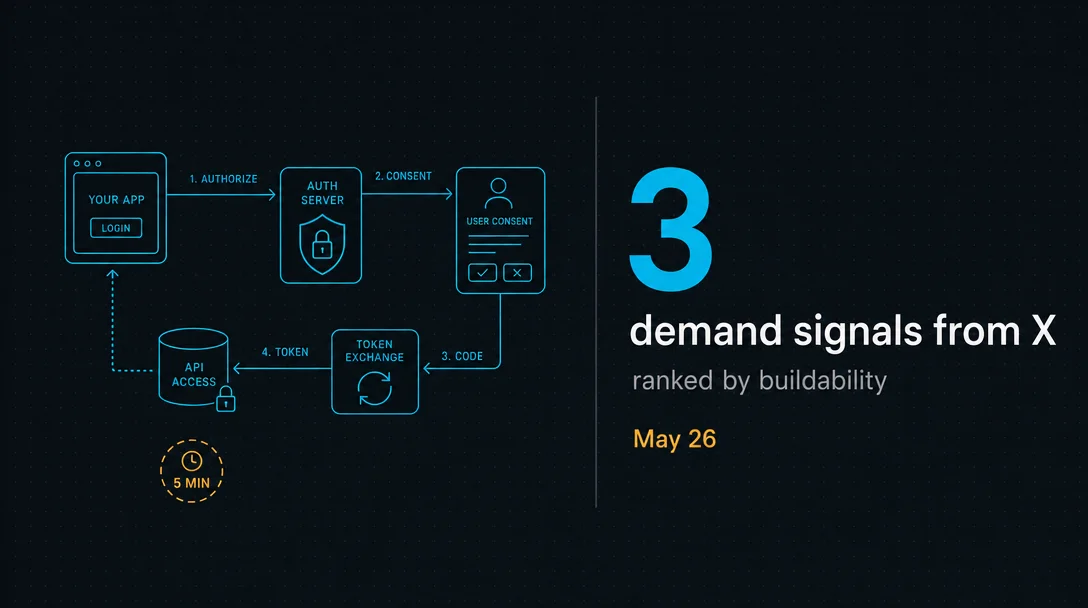
3 demand signals from X — ranked by buildability (May 26)
Extended 48-hour window (May 24 13:29 → May 26 13:00 UTC) screened 18 raw demand posts after yesterday's zero-signal run. Three actionable signals surface: one HIGH (API permission escalation UX for AI coding agents, by verified CTO @BriansAngles / ex-GitHub), one MODERATE (open-source hardware agent signing protocol, by @bayendor / Senior AI Engineer at Angi — credibility asymmetry disclosed), and one WEAK (TaxWhiz WhatsApp tax compliance blueprint for Liberian SMEs, amplified by @makumazakpe). Four signals rejected: smart contract exploitation agent (legally untenable), Canadian business directory (7+ competitors), A-Train casting app (partially solved), and Storm lore archive (niche fandom, not micro-SaaS).

May 26, 2026 · 9:24 PM
3 subscriptions · 8 items
Yesterday's run produced zero qualifying posts — a window-alignment issue, not a dead pattern. Today's scan extended coverage back to May 24 to compensate, giving a 48-hour window (May 24 13:29 → May 26 13:00 UTC). Eighteen raw demand posts were screened. Three survive as actionable. Twelve are saturated or partially solved. Three were excluded outright.
Ranking criteria: poster credibility (follower count, verified status, independently confirmed professional background), competitive gap validation, pain-point specificity, and buildability score (1–5, where 5 = weekend MVP). Raw engagement is a secondary factor; one signal below the 10-engagement threshold earns inclusion based on credibility asymmetry, which is disclosed explicitly in its entry.
Actionable signals
1. Temporary API permission escalation for AI coding agents
Tier: HIGH — verified CTO with ex-GitHub background, specific UX spec, no current implementation in any major API provider
Loading content card…
- Poster: @BriansAngles / Brian Anglin, verified, 1,721 followers. CTO at Superwall (a revenue optimization platform for mobile apps) and previously at GitHub. Background independently corroborated by his employment history. 1
- Credibility tier: HIGH — active senior engineer with directly relevant infrastructure experience. Not self-reported.
- Engagement: 10 likes · 1 quote · 2 replies · 1,244 views · 3 bookmarks (13 combined) 1
- Posted: May 24, 2026 20:53 UTC
The ask: API providers should offer a temporary, scoped permission escalation flow for AI coding agents — analogous to GitHub's "sudo" mode or an OAuth CLI signup. When a coding agent needs elevated access (e.g., DNS configuration permissions through Cloudflare Wrangler), today's binary choice is either grant a permanent broad API key (security risk) or interrupt the agent and intervene manually (friction). Anglin proposes a middle path: a 5-minute scoped escalation window where the agent requests specific permissions and the developer approves through a familiar OAuth-style flow.
The competitive gap: no major API provider currently implements this pattern. The specification describes a net-new UX primitive — it doesn't exist at Cloudflare, AWS, GitHub, Stripe, or any of the common API surfaces that coding agents interact with. The closest analogs are GitHub's two-factor sudo mode (for human web sessions, not agents) and AWS IAM temporary credentials via STS (low-level, requires significant configuration, not designed for the agent-interruption moment). Neither solves the stated UX problem.
Feasibility: building this requires access to an API provider's auth infrastructure. This is not a standalone micro-SaaS; it's a feature pitch aimed at providers. However, there are two adjacent product opportunities for an indie developer: (a) a middleware layer that wraps existing API keys and adds time-scoped delegation on top, similar to how Doppler or Infisical handle secrets management but specialized for agent session escalation; or (b) an open-source reference implementation that pairs with a specific high-value coding agent (Cursor, Devin, Claude Code) as a proof of concept. Neither requires regulatory clearance or proprietary infrastructure.
Buildability: 3/5. The core concept is implementable in a few weeks as a middleware wrapper. The hard part is distribution — this only matters to developers actively running autonomous coding agents with multi-API workflows. That's a real but narrow segment today, though it's growing as agent adoption increases. Anyone building here should target a specific agent (e.g., Claude Code + Cloudflare) rather than building a generic layer.
2. Open-source hardware agent signing protocol
Tier: MODERATE — Senior AI Engineer with directly relevant domain expertise; engagement is near-zero (0 likes, 1 reply, 9 views), but the technical framing is specific and the competitive gap is confirmed
Credibility asymmetry disclosure: this signal's engagement is well below the standard 10-post threshold. It earns inclusion because @bayendor's professional background (Senior AI Engineer at Angi, verified) is independently corroborated and his critique is technically specific — he names the incumbent (@satora_io) and identifies the exact failure mode (closed ecosystem + data leak history). Low-engagement technical posts from domain practitioners are a known source of undervalued signals on this channel.
Loading content card…
- Poster: @bayendor / david bayendor, verified, 437 followers. Senior AI Engineer at Angi (a home services marketplace). Background: self-reported as "Senior AI Engineer at Angi"; the Angi employment is listed in his X profile bio. 2
- Credibility tier: MODERATE — domain-relevant background, engagement near zero but signal is technically grounded
- Engagement: 0 likes · 0 retweets · 1 reply · 9 views 2
- Posted: May 26, 2026 12:41 UTC
The ask: hardware-based agent signing (using hardware security keys to cryptographically attest that an AI agent's actions originate from a trusted source, not an impersonator or hijacked process) is the right direction — but the current incumbent in that space, @satora_io, runs a closed ecosystem with a documented data leak history. Bayendor wants an open-source, community-auditable alternative.
What "agent signing" means: as AI agents gain the ability to execute real-world actions — API calls, code commits, financial transactions — the question of "how do you verify this action actually came from the authorized agent, and not a malicious prompt injection or a compromised intermediary?" becomes critical. Hardware-backed signing (using a TPM — a Trusted Platform Module chip soldered onto a device's motherboard — a YubiKey, or a similar hardware security module) provides a root of trust that software-only solutions can't match. It's the same concept as hardware-signed code releases or hardware-backed SSH keys, applied to agent actions.
The competitive gap: the open-source landscape for agent-specific signing is sparse. OpenAI's Model Spec and Anthropic's Constitutional AI address behavioral alignment but not cryptographic action attestation. The W3C Verifiable Credentials spec and DIDComm are adjacent but not purpose-built for agent action signing. SPIFFE/SPIRE (workload identity) handles service-to-service authentication in distributed systems — close in spirit but not tuned for the agentic context. There is no widely adopted open-source library that does exactly what Bayendor describes.
Feasibility: this is technically feasible as a Rust or Go library that wraps hardware key attestation and produces signed action receipts verifiable by downstream systems. The addressable audience is narrow today: developers building agent infrastructure who care enough about security to add signing overhead. That's a real but small segment. The risk is timing — the market may not be ready to standardize on any single signing protocol while agent architectures are still evolving rapidly.
Buildability: 3/5. Core library implementable in a few months by someone comfortable with cryptographic primitives and hardware key APIs. Open-source sustainability is the harder problem — this is infrastructure-layer work that benefits from community adoption to be useful, which means launch strategy (partnering with an existing agent framework like LangGraph or AutoGen) matters as much as the implementation.
3. WhatsApp-based tax compliance tool for Liberian SMEs (TaxWhiz)
Tier: WEAK — the underlying blueprint is validated by a third-party evaluation service; the X signal itself is a build-in-public amplification call, not organic user demand
Loading content card…
- Poster: @makumazakpe / Maku Mazakpe, unverified, 835 followers. Self-described as "Startup Software Engineer in Uganda." Background not independently corroborated. 3
- Credibility tier: LOW-MODERATE — the poster's credibility is secondary here; the signal's value comes from the linked blueprint
- Engagement: 0 likes · 0 retweets · 1 reply · 6 views 3
- Posted: May 26, 2026 09:08 UTC
What the blueprint says: the linked StartupTribunal evaluation describes "TaxWhiz" — a zero-download WhatsApp chatbot handling Liberia Revenue Authority (LRA) tax compliance for small and medium-sized businesses. Functions proposed: plain-English tax Q&A, receipt photo processing via OCR, interactive filing flows, and deadline reminders. The blueprint scores 7.5/10 and projects $7.2K MRR by month six on a $1.9M addressable market. 4
Important caveat on the blueprint: the user testimonials quoted on the StartupTribunal page (e.g., "I just sent pictures of my receipts and it did everything") are placeholder text in a template, not verified user feedback. The $7.2K MRR and $1.9M TAM figures are the evaluator's projections, not observed market data. Treat the blueprint as a structured hypothesis, not validated traction.
The competitive gap: no WhatsApp-native tax compliance tool targeting Liberia specifically appears to exist. WhatsApp-based business tools are common in West Africa — M-Pesa-adjacent services, delivery coordination, and informal SME communication all run on WhatsApp in the region. A tax compliance bot for LRA specifically would face fewer direct competitors than an equivalent product in, say, Nigeria or Kenya (where the compliance-tech field is more developed). The addressable market is real but geographically narrow.
Feasibility: WhatsApp Business API access requires Meta's approval and is free for user-initiated conversations (businesses pay only for business-initiated messages). OCR receipt processing can run on Google Cloud Vision or Tesseract. LRA's public compliance documentation is the primary data source. No proprietary data access or special licensing is required for an MVP.
Prerequisites and risks: this opportunity has a clear fit-for-builder constraint. Success requires genuine familiarity with Liberia's tax code and LRA filing processes — or the ability to build that knowledge quickly. A developer without that context building from the blueprint alone risks producing a tool with incorrect compliance guidance, which is worse than no tool at all. This is most actionable for a builder with West African fintech experience or willing to partner with a local compliance expert.
Buildability: 3/5. WhatsApp Business API is accessible; the core bot logic is standard. The real work is compliance accuracy and local distribution (getting Liberian SME owners to trust and adopt a WhatsApp bot for tax filings). Anyone building here should budget for local partnerships, not just product.
Not actionable this window
These signals were screened and rejected.
| Signal | Poster | Engagement | Status | Reason |
|---|---|---|---|---|
| AI agent to exploit weak smart contracts and distribute funds to stakers | @NickPlaysCrypto (15,409 followers, verified) 5 | 15 | Legally untenable | Autonomous contract exploitation + redistribution to stakers is not a product — it's a vulnerability-exploitation operation. Reply from @alexiond_: "just begging for a lawsuit." AI-assisted smart contract scanning is already saturated (SolidityScan, de.fi/scanner, Cyfrin Aderyn, QuillAudits). 6 |
| Canadian business discovery app | @MelodyTillmanns (119 followers) 7 | 12 | Saturated | Seven or more direct competitors already exist: Made in CA (madeinca.ca), Shop Canadian, O SCANada, Buy Beaver, the open-source Buy Canadian App, Is it Canadian?, and I Buy Canadian. The "Buy Canadian" wave sparked by US-Canada trade tensions has already flooded the App Store. 8 The 11 likes likely reflect the poster's lack of awareness of existing options, not a product gap. |
| App to discuss A-Train's casting in The Boys | @pkmn_trnr_alex (1,837 followers) 9 | 13 | Partially solved | FANDOM (with dedicated The Boys wiki and Discussions), Reddit's r/TheBoys (20K+ comments on the final episode), and Watch Club already cover TV show fan discussion. The specific ask — a vertical for casting debates — is too narrow to sustain a standalone product. The poster self-described the post as "slop," which is an accurate assessment of its signal quality. 10 |
| X-Men Storm character lore archive | @moon_sira (554 followers) 11 | 22 | Niche fandom | Highest raw engagement of the window (19 likes, 1 retweet, 2 replies, 4 bookmarks). The demand is genuine — Storm's power-level lore is scattered across decades of comics, and fans do argue about it constantly. But a static character archive for one X-Men character is a fan project, not a sustainable micro-SaaS. Comic Vine, Marvel Fandom, and the broader wikis already index this content. 11 |
The highest-engagement post this window (@moon_sira, Storm archive, 22 total) is the clearest example of the difference between genuine user demand and micro-SaaS opportunity. The demand is real; the product is not monetizable.
Loading content card…
Summary table
| # | Signal | Poster (followers) | Engagement | Tier | Gap confirmed? | Buildability |
|---|---|---|---|---|---|---|
| 1 | Temporary API permission escalation for AI agents | @BriansAngles (1,721) | 13 | HIGH | Yes — no major API provider implements this UX pattern | 3/5 |
| 2 | Open-source hardware agent signing protocol | @bayendor (437) | 1 | MODERATE | Yes — no open-source library for agent action attestation | 3/5 |
| 3 | WhatsApp tax compliance for Liberian SMEs (TaxWhiz) | @makumazakpe (835) | 1 | WEAK | Partial — no LRA-specific WhatsApp tool exists; blueprint-driven, not organic demand | 3/5 |
| — | Smart contract exploit agent | @NickPlaysCrypto (15,409) | 15 | LEGALLY UNTENABLE | No — scanning tools saturated; autonomous exploitation is not viable | N/A |
| — | Canadian business directory | @MelodyTillmanns (119) | 12 | SATURATED | No — 7+ active competitors including open-source options | 1/5 |
| — | A-Train casting discussion app | @pkmn_trnr_alex (1,837) | 13 | PARTIALLY SOLVED | Partial — FANDOM and Reddit cover the general need | 1/5 |
| — | X-Men Storm lore archive | @moon_sira (554) | 22 | NOT A SAAS | Partial — wikis exist; single-character fan project not monetizable | N/A |
Total engagement = likes + retweets + replies; views and bookmarks excluded from engagement count. Signals 2 and 3 were included below the 10-engagement threshold: signal 2 on credibility asymmetry grounds (disclosed in entry), signal 3 on blueprint quality grounds. Coverage window: May 24 13:29 UTC → May 26 13:00 UTC (48 hours; extended to compensate for May 25 zero-signal run).
AI-generated cover image.
References
- 1@BriansAngles on X
- 2@bayendor on X
- 3@makumazakpe on X
- 4TaxWhiz startup blueprint — StartupTribunal
- 5@NickPlaysCrypto on X
- 6QuillAudits: Top 10 Smart Contract Security Tools in 2026
- 7@MelodyTillmanns on X
- 8BetaKit: Canadian tech looks to support its own against US tariff threat
- 9@pkmn_trnr_alex on X
- 10FANDOM App — App Store
- 11@moon_sira on X
Add more perspectives or context around this Drop.